I’ve always marveled at how few politicians and candidates actually connect with the people they serve, and especially their supporters. Whether it’s explaining a key vote that might not be so popular or a simple moment of joy, being genuine is often less important than being “on message.”
Many are more comfortable speaking to the media than speaking to the people who put them in office.
Senator Al Franken is one of those rare exceptions. Whether you voted for him or otherwise, he’s never shied away from connecting on a human level.
Nor has he been afraid to make part of his personal life public. Case in point is the brief email below (which was nicely optimized for my mobile phone):
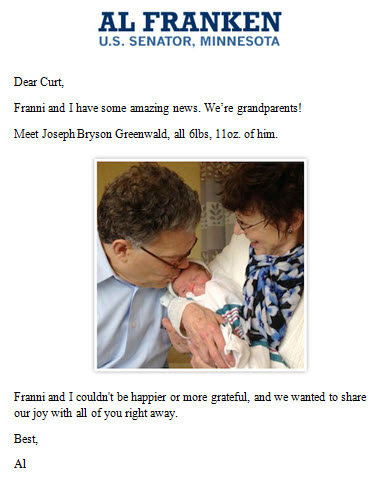
Congratulations on becoming a grandpa, Senator Franken.
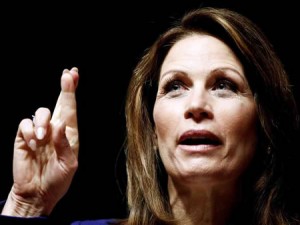
Both sides of the media aisle lit up on Wednesday after Congresswoman Michele Bachmann announced that she wouldn’t seek re-election. As a Minnesotan who’s closely watched her rise to office—often firsthand, I’m honestly glad to see her leave public office, and curious to see where she’ll land.
As a political consultant, I’m with the comedians and editorial cartoonists–I’ll be sorry to see her go.
Since her announcement, most of the accolades, criticisms and comedic pans at Michele Bachmann the public official or the candidate overlook some of her greatest strengths: she was an innovative campaigner and fundraiser.
Unlike many candidates, Bachmann never allowed her political consultants to suffer from path dependence—a psychological habit that puts faith in prior experience and past successes even when conditions have obviously changed. Like an entrepreneur, she sought out the opportunities and tools that often weren’t even applied in business, let alone the political world.
Her insatiable hunger for power required her to push technology when other campaigns were still struggling with the telegraph.
That drive helped her directly raise over $35.4 million over her political career—largely from small donors. It also helped her attack opponents well beyond their radar and competency to fight back…at a fraction of the cost of traditional media.
In 2006, the largely unknown Bachmann first used interactive tools—heavy banner advertising combined aggressive email efforts focused list building via third-party acquisition. She bested her better-known opponent by over 8 points.
After narrowing winning re-election by 3 points in 2008, Bachmann joined Twitter and Facebook. She eventually built a following of over 240,000 and 500,000 respectively. And years before many of her colleagues and detractors would post photos of them kissing babies, she incorporated video to cut funding for ACORN, surveyed supporters for talking points and actively converted Facebook “likes” into millions of donations.
During the 2010 mid-terms, her campaign first experimented with mobile. They used geo-targeted mobile ads during the Minnesota State Fair that painted her opponent as someone who “raise taxes on your corn dog and your deep-fried bacon and your beer.” She won by a generous 12.7 point spread.
And in the 2012 GOP Presidential Primaries, Bachmann pulled out all of the stops. They leveraged mobile web sites, SMS, Facebook mobile ads, social media and tightly geo-targeting mobile campaigns throughout Iowa and New Hampshire. The efforts earned her a win at the Iowa Straw Polls, and tactic adoption by the Romney campaign.
Eventually, Bachmann’s innovative efforts exceeded her capacity as a candidate—which might be a first in political campaigns. (Hadn’t that have happened, the political strategist in me would’ve savored the magic a Bachmann presidential would have created with access to $100s of millions.)
Instead of downplaying Bachmann the public official, political operatives would do better to learn from her as a campaigner. Her fellow tea partier Senator Ted Cruz did, but he’s an exception even on both sides of the aisle.
Like every mid-term, 2014 will be tougher campaign year for the party in power. Candidates should leverage innovative tactics that she’s proven effective.
-Curt Prins
If you don’t know who Ted Cruz is, you’re about to. Last weekend, Sen. Cruz (R-TX) gave the keynote address at the annual Conservative Political Action Conference (CPAC), and walked away with 16,000 of the most conservative political activists in the country.
Here’s how:
With one simple request, the senator invited these activists spread his message and amassed a powerful list to support his leadership PAC: Jobs Growth & Freedom Fund. After repeating his call-to-action, the senator’s Facebook and Twitter page included. Within 24 hours, the SMS list over 17,000.
What can we learn from this?
- Most Speeches Are Forgettable: Of the thousands of people that heard his speech on-site or online, few people will remember exactly what he said. Using speeches is an effective platform for building your mobile list and remaining connected to your supporters.
- Nothing Beats Personal Ask: There many ways to invite people to opt in to your mobile list, such as email, campaign collateral and social media. But nothing will beat person-to-person requests.
- Keep Keywords Simple: Sen. Cruz is the common word and is call-to-action to make it memorable and easy to answer. He could have used his name, but people could have easily misspelled it.
- Repeat Repeat Repeat: While not everyone can speak at national events like CPAC, repeating a call to action for social media and other tools can extend the return.
- Don’t Botch the Opt-in Reply: One mistake Sen. Cruz did make is sending a lackluster message to all those who opted in. The candidate should have sent the link to his PAC or requested further information from the subscribers like their zip code.